There’s a moment every growing print shop hits. Orders are up, the screen press is maxed out, and you’re turning away work that doesn’t hit minimums or can’t justify setup costs. You know DTF is the answer — but the market is flooded with cheap printers, mismatched cutters, and heat presses that create more bottlenecks than they solve.
M&R’s DTF range — the Quatro printer, the Cutter, and the Orbiter automatic transfer press — is built for shops that are done cobbling things together and ready to do it properly.
The Full Setup: Print. Cut. Apply. Done.
Most DTF setups are assembled from different brands — a printer from one supplier, a cutter from another, a heat press from a third. The result is a workflow full of compatibility gaps, inconsistent results, and manual touchpoints at every stage.
M&R’s answer is a complete, purpose-built ecosystem where every machine is designed and tested to work with the others from day one.
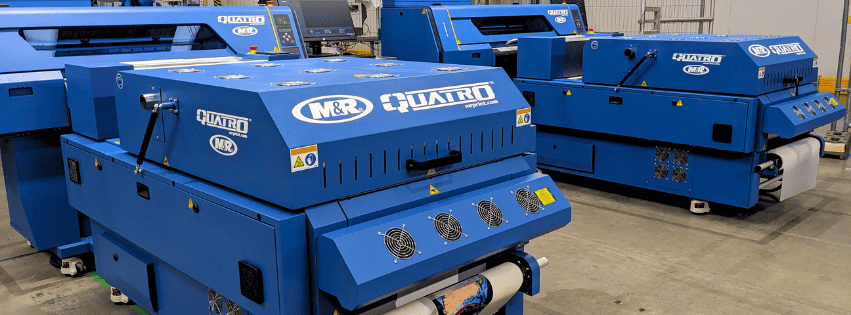
The Quatro DTF Printer handles print and cure in one continuous process, with an on-board powder adhesive system, integrated exhaust filtration, and M&R’s Positive Link System ensuring accurate film tracking between the printer, powder applicator and dryer. Film tracking errors are one of the biggest sources of waste in mismatched setups — M&R eliminates them by design.
The Quatro Cutter removes the bottleneck of manual trimming entirely. The Cutter X handles inline linear cutting at up to 90 linear feet per hour with automatic crop mark detection. The Cutter XY goes further — full contour cutting with digital camera and QR code support, handling gang sheets, individual transfers, and complex shapes automatically.
The Orbiter is where the range changes the production maths entirely. Not a standard heat press — a rotary carousel machine engineered specifically for DTF to automatically apply , producing over 360 transfers per hour under optimal conditions. Its rotary indexing base splits heat press time across multiple platens, turning passive waiting time into active pressing time. Three heat presses, including a post-peel station, all fit through a standard 36-inch doorway.
Together, they cover every stage of DTF production — print, cure, cut, apply — under one roof, from one manufacturer, with one support team behind it.
What Sets It Apart
Built, Not Imported
Most DTF equipment flooding the market right now is manufactured overseas and distributed through non-accountable channels. M&R has resisted that model entirely, maintaining its ethos of building long-lasting, high performance, robust and serviceable platforms — to the same standard as their screen printing presses that shops are still running after decades.
Colour Accuracy Competitors Can’t Match
The Quatro 68’s six Epson i3200 print heads — two CMYK, two VRGO, and two White — reproduce reds, oranges, greens and violets as true spot colours rather than approximations. A standard CMYK-only DTF printer simply cannot do this. For shops producing branded merchandise, sportswear, or anything where colour accuracy matters, this is a genuine differentiator.
Speed Without Sacrifice
Unlike other printers that slow down when more ink channels are added, M&R engineered the Quatro to hold a steady 60 linear feet per hour regardless. More colour, same speed. That’s not a given — it’s an engineering decision most competitors haven’t made.
Software Included, Not an Afterthought
Both Quatro models include M&R’s RIP software powered by Caldera, eliminating the need for third-party tools and the support gap that comes with them. Cheaper setups charge separately for RIP software and leave you managing two different support relationships when something goes wrong.
Why It’s a Smart Investment
The market is growing — fast. The DTF printing market was valued at $2.72 billion in 2024 and is projected to reach $3.92 billion by 2030. Shops that invest now with the right setup capture that growth. Those that wait will be playing catch-up with inferior equipment.
It attacks your biggest cost: labour. The Orbiter’s 360+ transfers per hour replaces what would otherwise require multiple operators running single presses. One operator overseeing a properly integrated M&R setup outproduces a team manually managing individual heat presses. That difference goes straight to your cost per unit — and straight to your margin.
It unlocks revenue you’re currently turning away. No screens, no setup costs, no minimum orders. Single-item customs, short runs, complex full-colour artwork — all profitable. Every job you previously couldn’t take is now money in the door.
It’s built to last. The depreciation curve on a well-built M&R machine is fundamentally different from a budget DTF printer. Cheaper alternatives are built to a price point. M&R equipment is built to a standard — and that’s a very different risk profile for a capital investment.
The short version: a cheap DTF setup gets you started. The M&R range gets you scaled.
The Bottom Line
The M&R Quatro, Cutter, and Orbiter aren’t three separate purchases — they’re one integrated production system. For any shop serious about scaling DTF output while keeping quality consistent and labour costs under control, there is no more complete package on the market right now.
The question isn’t whether DTF is the future of your shop. It’s whether you want to do it properly.