
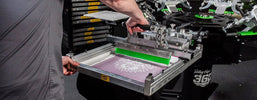
Talk to any screen printer who’s pushed ink through a thousand shirts and they’ll tell you the same thing: consistency is the hardest thing to sell. Your first print of the day looks great. Your four-hundredth? That’s where things get honest.
The Problem Every Shop Knows
Screen printing rewards repetition — but the human body doesn’t. Squeegee angle drifts. Flood stroke pressure changes. Operators fatigue. The result is the quiet inconsistency that shows up as colour variation across a run, ink deposit that shifts mid-job, or the inexplicable reprints that eat into margins at the worst possible time.
Training new staff only multiplies the challenge. Technique takes time to develop, and time is exactly what a busy production floor doesn’t have to spare. Most shops have learned to simply tolerate a certain level of variability — to build it into their pricing, their waste allowances, and their client conversations.
The Rudy Press was built on the premise that variability shouldn’t be the default. It should be the exception.
“Eliminate guesswork and bring reliable results to every print job — whether you’re training new staff or optimising an existing setp.”
What the Rudy Press Actually Does
The concept is straightforward. The Rudy Press clamps directly to your screen and guides each stroke — floods and print passes alike — through a controlled, repeatable path. There’s no complicated installation, no new equipment to integrate into your workflow. Clamp it on, load your ink, and start printing.
What that guided motion delivers, across a full production run, is something most shops have only experienced at the start of a job: uniform floods, consistent ink deposit, and repeatable results cycle after cycle. The mechanical guidance means the stroke is doing the work, not the operator’s memory of what a correct stroke feels like after hour six.
For busy production environments, that’s the real value. Operators stay fresher through long runs because they’re no longer fighting fatigue-driven technique drift. Output climbs. Reprints fall. The floor moves faster.
01
Consistent Floods
Guided strokes deliver uniform ink coverage every time, eliminating the variation that causes colour inconsistency across a run.
02
Operator Endurance
When the tool guides the technique, operators stay fresher longer. Less physical compensation means less drift on extended runs.
03
Faster Onboarding
New staff get repeatable results from their first session. Training time drops without sacrificing print quality.
04
Higher Hourly Output
Smoother workflows and fewer reprints compound across a shift. Shops report measurable gains in throughput without adding headcount.
